Wednesday, March 01, 2006

Strange Theodicy

A guy claiming to be a reverend, a certain Fred Phelps, is taking protests to funerals with the argument that bad things happen to good peolpe because America tolerates homosexuality. The Jefferson City News Tribune has an editorial condeming these protests, which gives a little background on the story. Missouri and other states have imposed a content neutral ban on demonstrations within an hour of a funeral. Here is a News Tribune news account of the legislation's passage. Two days earlier there was a story when the House passed the legislation.

Tom Scharbach over at Purple Scarf has found a source that suggests Phelps is actually an agent provocateur to discredit Biblically based opposition to any gay-friendly agenda. While its certainly possible that Phelps is an agent provocateur, I think its just as likely that he and his supporters are just nuts, and have no clue how much opposition they will get from the Right. By pitting a conservative warm regard for the military against a conservative hostility to any gay-friendly agenda, Phelps will inevitably split conservatives. By employing such an unpleasant tactic, its also inevitable that the weight of opinion will be against Phelps.

I am told that Phelp's people are praying outside the Missouri State capitol this morning, and have been given information about how Phelps and his protestors disrupted Lutheran services during discussion of the ELCA's position on homosexuality which involved serious injuries to a minister who approached the protestors to ask that they withdraw and allow the service to procede without disruption. Attacking clergy in the name of God certainly has to fall into the catagory of "things that will alienate your natural constituancy." Dennis Prager has identified that the Commandment against "taking the Lord's name in vein" means to attach God's name to a cause which is not Godly, and has nothing to do with swearing. In the current situation globally, this often refers to Islamicists who use terror in the name of Allah. It would seem that Phelps' efforts likewise qualify as a distinctly unGodly set of tactics (and perhaps purposes) dressed up under a Godly banner.

As I have posted once or twice, I don't think the Bible issues general condemnations of homosexuality. I do think the Bible frequently issues condemnations against the adoption of practices of neighboring people. This rejection of cultural assimilation has allowed Jews to maintain a distinct identity despite three thousand years of hardships, domination, and oppression. If a neighboring people engaged in distinctly different sexual practices, its to be expected that the Bible would condemn them as foriegn. If people ate distinctly different foods, that too would be forbidden. And if they worshiped different gods, that also is forbidden. The condemnations in the Bible reject assimilation to neighboring lifeways as a means of preserving a distinct identity, not because any of the prohibited actions (whether style of dress, foods, family arrangements, or sexual practices) are neccesarily bad. Of course there are prohibitions on some bad acts, whether medically (some of the dietary laws are good health advice), or because it is meant to invoke some attention to moral issues (such as the proscription of ways of killing an animal to be as humane as possible, or the injunction of an eye for an eye as a prohibition of demanding a life for an eye, or the slaughter of a family for an eye).

Distinguishing between universal claims of a text and simple descriptions of a particular set of conditions requires a level of text criticism which apparently eludes Fred Phelps. No doubt he reads the injunctions against bathing not to refer to Greek or Roman style bathing, but as a universal prohibition on bathing. Whether Phelps is an agent provocateur or just an idiot, its clear that his efforts do undermine his cause.
Europe and American-style Conservatism

The American Right is a combination of liberalism (liberty seeking) and conservative (order seeking) while the American Left is a combination of liberalism and socialism (equity seeking). Europe has actual liberals, conservatives, and socialists. Attempts to build a coallition of economic liberals and social conservatives proves hard in Europe, as this piece in the Brussels Journal demonstrates. Liberals are wary of funding them, because of the social conservatism, and conservatives seem to not be interested either. In the comments you can see the Liberals posting warrily about how an illiberal social policy can support a liberal agenda (the notion that liberal economics is best insured by a Christian society). The Brussels Journal mostly publishes about its Liberal agenda of smaller goverments, EU-scepticism, lower taxes, less regulation, and free trade. As such its not a regular stopping point for European conservatives who might otherwise be posting in complaint of a social order which does not protect its people from the vicitudes of a liberal economy.
VDH nails it in the WSJ

A Nation Divided.

Monday, February 27, 2006

Thoughts on the Ports Contraversy

Let's start with a clarrification. Neocons are not advocates of commerce making friends, that's a different wing of the right. Its Hamiltonians who believe that commerce breeds a middle class and that middle class values produce democracy and liberal societies. Neocons invade Iraq to establish a democracy. Hamiltonians trade with Iraq to build a middle class who then demand a democracy.

The Hamiltonian thesis requires a long time to play out. Little countries like Korea and Taiwan took 50 years to go from unfree, western aligned states to functioning democracies. A big country like China will take longer. Start counting for China in 1976 when Mao died. Just as the revolutions in 1848 were a false start for Germany, where industrialization and the growth a middle class was too small to sustain the revolutions, Tiananmen was a false start for China. But like Germany, in a century (or perhaps more, China's too big to extrapolate reliably) China will have too many middle class people to accept a tyrannical regime.

Neocons advocate a risky, rapid democratization. Hamiltonians advocate a slow, steady development.

Regarding the UAE, because of the psychological crisis of "the failure of the Islamic" world in the 20th century, the best analogs are the 2nd phase democracies: Italy, Germany, and Japan. The countries had a substantial and growing middle class, but they also had a group of radicals owing to the Great Depression and unresolved trauma from WWI. As a result, their democratic development was vulnerable to being hijacked by the radicals. Arab states likewise have two forces largely at war with one another. The modernizing, westernizing, commercially oriented people, and the backward looking Islamic fundamentalists who want to re-create an imagined past of Islamic greatness. What the bombings in places like Saudi Arabia reveal is that these two forces are at war with each other in the Islamic world.

In fact, the thesis of Fawaz Gerfes _The Far Enemy_ and the historical background to Marc Sageman's _Terror Networks_ is that this struggle between the modernizers (those who think the Arab world can catch up to the west by becoming Modern, as the Japanese did between 1854 and 1954) and the Islamicists (those who think Islam becomes great by becoming salafi, Koranic, and sharia) has been going on since the fall of the Ottoman Empire, and it was the specific shift in the ideology of Al Qaeda from fighting the local modernizers to fighting the exemplars of all that is modern, the United States and the West, which had forced us into this struggle.

Therefore it is a great error to regard all Arabs as potentially sympathetic to the Islamicists. Our allies in the Arab and Islamic world are the modernizers. Because they are in the heart of the struggle and are the direct targets of all Islamicists (and were long before Al Qaeda) being that they are the Near Enemy, we need to aid, protect, and guide them to a secure modernism. At the same time, we must understand that demanding that they openly and fully declare allegiance to full modernity makes them a target, not only of Islamicist violence but of all the anti-modern forces in the Arab and Islamic worlds. As such, even genuine modernizers will attempt to appear traditional by kow towing to traditional idols, such as Islamic charities, anti-Israeli declarations, and madrassas. These kinds of things happen in the most modern and Western oriented countries in the Arab and Islamic worlds. Its a sign of their insecurity, not their bad intentions. We will know we are winning when the modernizers no longer have to apologize for their modernity by kow towing to traditional Arab or Islamic institutions, causes, or ideas.

Some of the criticism of the UAE’s could be leveled at the Swiss, the Caribbean, or Hong Kong banks. One of the things we saw in 9-11 and from Al Qaeda is the ability to use our modernity against us; flying our planes into our skyscrapers by taking advantage of the open access of our society. Certainly they are doing the same to the modernizers in the Arab and Islamic worlds.

People who are operating ports in many countries outside the Islamic world, employing technical and administrative skills to advance commerce, these are the modernizers. They are our friends. We will not advance the cause of liberal societies (and would repeat the mistakes Michael Ledeen describes in _Freedom Betrayed_) by regarding Arab modernizers as potential Islamicists.

Sunday, February 12, 2006

Coulter gets slammed

Its nice to see Ann Coulter take one on the chin. She took her hyperbole and over the top schtick to CPAC and was rejected. The American Mind reports just how bad reviews were. She's much more useful to the left, providing a living breathing straw man, than she is on the right. Further her attachment to any cause becomes a liability that has to be overcome, she's no assett.

Monday, February 06, 2006

Cuddle Puddles and the New Modesty

This is something of a continuation of the previous post from yesterday. Still reading the Atlantic, still on the culture wars.

I read Caitlin Flanagan's Are You There God? It's Me, Monica. It hit many of the same points as the Laura Ingraham interview with someone behind the piece on the Cuddle Puddle in New York Magazine.

But at the same time that I see evidence for the new decadence, I still see evidence for the new modesty. There is Mona Charen's piece, A Modest Backlash Against the Culture. It refers to a group blog called Modestly Yours in which the issues of modesty are discussed. There is the Modesty page on Ladies Against Feminism.

My interpretation of both trends suggests that the ends of the bell curve are getting further apart. Another dominant culture is fragmenting and womanhood and girlhood are giving way to a series of distinct cultures with totally different value systems. Modesty may only describe a small group (let's suppose somewhere between a tenth and a sixth of females), and decadence may likewise describe a similar small group. In between we might find everything from 50's style petting to serial monogomous sex between teens based on stable (for teens) relationships.

The abstinance movement is real, and the kind of casual sex with strangers and multiple partners (Ingraham described the cuddle puddle as an orgy) seems to be real as well. I suspect that the modesty movement is more a responce to the decadence than what is going on in the middle. There is an ongoing discussion of what 's going on, as these sources begin to link to one another.

Sunday, February 05, 2006

Deceptive Chart

The Atlantic has an interesting piece on twelve tribes of American votes, divided according to their views on religious issues. There is a chart, featured much more on-line than in print, which I think is deceptive. (Non-subscribers can see the chart, but not the article.) Consider the group, White-bread Protestants. This group is described as the heart of the old Republican Party, the country club Republicans who supported Republicans from McKinley to Ford. Some have gone to the left some to the right. They sure sound like center-right swing voters. The kinds of voters who are required for Democrats to win, but would normally default to Republicans.

Looking on the grid lines, they are on the mid-point of the economic values axis, perhaps a touch more conservative. However on cultural values, they are two grid lines to the left of the center line, only two grid lines from the edge of the chart. Another group described as "true moderates" are the Convertible Catholics who are one grid line to the left on both economic and social issues.

This chat deceptivly makes it look like moderates and leftists are clustered closely together, implying agreement, while the religious right ends up off in a corner by itself, impyling that its views are far from anyone elses.

Wednesday, February 01, 2006

Taranto on the Adversarial Media

James Taranto has a good peice at Opinion Journal dot com on the failures and growing challenges of the adversarial media.

Tuesday, January 31, 2006

Steve Colbert on Religion

Ann Althouse has an interesting set of comments and a few links on Steven Colbert's thoughts and comments on religion. She seems to have uncovered a serious side to the comic.
More on Boys and Education

The recent Glenn and Helen podcast interviewed Michael Gurian, author of The Minds of Boys. He argues that the industrial school is not a good fit for 30-40% of boys and 10% of girls. Last week, I reported my own findings from my experience. I found that a third of boys and a sixth of girls seemed unable or unwilling to stay on task in a classroom. Our numbers are pretty close together, and I am describing a behavior, so other causes might confound explanation of the Gurian thesis. Gurian on the other hand is describing a problem and its effect. Still the numbers are pretty close, and I think that's telling.

Monday, January 30, 2006

Those Beloved Judges

Hugh Hewitt was running audio of Sen Kenndey on the Alito filibuster today. Kennedy seems to have love only for the judicial branch of government. Only they solved the serious problems confronting America. The Founders were inadequate, so the Consitituion is no guide. The executive and legislative branches didn't do the specific things he mentioned, so they were inadequate. Only the judicial branch ensured progress for America.

Kennedy is in fact wrong, from Truman's desegreation of the Army in 1948, Lincoln's Emancipation Proclimation, the Voting Rights Act of 1964, and the 13th, 14th, 15th, and 19th amendements, it turns out that the other branches were active in advancing civil rights and freedoms in America. Further, one can argue pretty persuasivly that when courts have acted first (Brown v Board of ed, Roe v Wade) they have mostly pre-empted the other branches. Its pretty clear that in the various cases which could be pointed to, the courts were only a little ahead of the political branches, and had they not acted, the other branches would have. Further, the political branches typically avoid the excesses of the judciary (not always, but much more frequently) and where they do over-reach, its much easier to repeal bad legislation than it is to reverse bad decisions. Judicial actions, because they are non-political have much less support among the people. With the political branches, the people get to weigh in and possibly over-turn executive or legislative over-reach. As such, judicial cases cause a back-lash that political action doesn't cause. This is because when you fight in a legislature or in elections and lose, you had your say and you can wait to put someone of your mind in office soon. In a court case, the people are not consulted and checks on the courts by the people are nearly absent.

Kennedy is not only factually wrong about the role of the courts as the sole institution of progress, but he embraces the least democratic and most tyrannical branch of government as the one to vest the most power in.

Monday, January 23, 2006

Self-Discipline and Schools

A recent study finds that self-discipline beats IQ as a predictor of success in schools. Since being smart is actually a hardship in schools, that's hardly surprising. Bright kids find it so easy to skate through on native intelligence that they have no motive to develope self-discipline to succeed in school. For parents to teach discipline often means discipline outside of an academic context. As a result bright kids in college either push themselves and self-teach good study habits, or they a) reproduce skating by or b) end up leaving school.

If schools challeneged bright kids, and gave them the kind of assignments that they actually had to apply themselves to do well on, then they would benefit from smarts and discipline. As it is, we largely ignore the needs of our gifted kids and assume they'll just do fine. Learn they will, no doubt, but they will not on their own cultivate then habits of hard work and success.

Saturday, January 21, 2006

Boys and Education

I was a fan of Christina Hoff-Sommers after Who Stole Feminism and was interested when I saw her War Against Boys. The War Against Boys argues that boy behavior is being labled as a problem. More recently, The New Republic has noticed the issue and this has sparked some comment in the blogosphere. This includes Ann Althouse, Stepping Stone, and Kirsten Mortensen. Ann's comments section is, as usual, abundant. As a boy who largely prospered under school and found typical school boy behavior disorderly enough that I joined the army after school looking for an orderly society, some of the suggestions for boys I think would work for some boys, but there also needs to be a middle ground between rambunctous school for energetic boys and dainty school for girls who can sit still for weeks on end.

I observed three catagories of students in the classroom. Those who sit still and remain on-task even with distractions, those who can remain on-task as long as there are no distractions, and those who simply don't remain on task. I found that 2/6 of girls and 1/6 of boys were nearly always on task. I found that 3/6 of both boys and girls could remain on task as long as distractions were eliminated. I found that 1/6 of girls and 2/6 of boys found remaining on task difficult under normal classroom circumstances. The things that distracted boys and girls wasn't neccesarily similar. Girls were more likely to be distracted by the opportunity to be social. But the always on task and the mostly on task students would seem to function well in the low energy and moderate energy enviroments. The other students I suspect will need a variety of strategies. Some need more discipline and regementation, some need a different teaching approach, some need more extenstive links to existing knowledge, and so on. 75% of students, however seem to be able to function well in some form of current school.
Blunt on Hugh

Last weekend I wrote my congressman, Roy Blunt and recommended he come out for all of the transparency issues and the sunshine. I also recommended he go on Hugh's show, and provided a link to Instapundit's join statement of bloggers. Whether my drop of water added to the filling of the bucket or not, Congressmen Blunt was on Hugh this Wednesday.

I admit to some favoritism of the native son variety, but I think Roy did fine.

Saturday, January 14, 2006

Zawahiri

The New York Times called him "Top Qaeda Aide", but ExpressIndia has it better when they note, "Zawahiri is the brains behind Osama bin Laden". Many of the news broadcasts I am hearing refer to him as Al Qaeda's number two man, but I think that is an error. Zawahiri is in some ways more dangerous than bin Laden. He is the chief ideologist and propagandist of Al Qaeda. Since bin Laden has gone underground, Zawahiri is the one releasing the video tapes. Bin Laden was a financial and organizational leader, but what today is being financed or organized? Yet even from caves, a message is getting out and that is Zawahiri. He may well be the top man at Al Qaeda, even if the Times calls him an aide.

Sunday, January 08, 2006

Tom Delay

Texas Tom is not my kind of Republican. Nevertheless, the baseless attack upon his PAC activity in Texas is stirring sympathy for him as far as I am concerned. If a PAC is a money laundering scheme, I think charities must also be money laundering schemes, not to mention the political parties. It certainly is possible to argue that PAC's as pools of money dilute the influence of any one giver (except in cases where the PAC is a front for a single person or interest). A PAC like Delay's was not a special interest PAC, and it wasn't beholden to a single donor the way MoveOn was to a certain currency speculator. It was performing the same function as the Republican Party, its purpose was to get Republicans elected in Texas. Some might be concerned with corporations donating money directly to candidates, though such organizations can still be influential when top officers all contribute anyway. But contributors to Delay's PAC were seeking influence with Delay (sort of) and not trying to do what was feared with direct corporate contributions. Since PAC contributions were legal, it should be obvious that this money laundering charge is a legal fiction.

All of this puts aside the notion that speech is protected, political speech more than commerical speech. Why can Company X run commercials advertising their product, but they can't take political positions? But that is a foundational question and won't be addressed in a court.

Delay's PAC is an example of a national politicial becomming a magnet for money because he is percieved as being effective. People who agree with him and find his agenda pleasing will send money to see Delay advance his agenda. As such its hard to see who was being corrupted by any of this.

Tuesday, December 27, 2005

Michael Yon

I came across a discussion of different takes on the Iraq War on Micheal Yon's site. But, I discovered a punditradio interview (just over 40 min) with Michael from the middle of August. Good stuff.

Monday, December 19, 2005

Merry Christmas

Heading off for holiday fun.

Monday, December 05, 2005

British Pension Reform

The Times of London has a good FAQ on the Turner Report and pension reform. It looks like the basics of the plan are these: A basic benefit to keep people out of absolute poverty, and mandated savings to cover the rest of the benefit, and encouragement to save, either with the program or elsewhere, at an even higher rate. This is more or less "partial privatization" in American parlance.

Sunday, December 04, 2005

Dilbert Blog

It seems Scott Adams has been blogging for about two months. Some of it looks like comedy writing, and some of it looks like a comedian's observations of life, and a small portion of it seems to be the more blog-flavored comments on current events.

"Yet another “third highest ranking al-Qaida leader” has been killed, this time by a rocket attack from an unmanned drone. There are a lot of jobs that I wouldn’t want, and “third highest ranking al-Qaida leader” is right at the top. "

Saturday, December 03, 2005

Order, Liberty and Equity

Conservatives are order seeking, liberals liberty seeking, and socialists are equity seeking. Reuters reports that Arab states are more concerned with security and are suspicious of the Bush Administration's liberty (democracy) agenda. Sounds like they're a buch of conservatives to me, looking to maintain the status quo, because like the monarchs of 19th century Europe, no one would think to put them in power otherwise.

America is a country born of revolution and always has been willing to rock the boat a little bit for freedom. Why should the US give more than a passing concern for the conservative forces of the Arab world?
Anti-War Indoctrination encounters obstacles at Allis

The Wisconsin State Journal reports that "A letter-writing campaign by third-graders at Allis Elementary School encouraging an end to the war in Iraq was canceled."

"Madison School Board policy prohibits teachers 'from exploiting the institutional privileges of their professional positions to promote candidates or parties and activities.' [...] 'We don't want our staff ever using our students in a political activity, which this obviously was,'"

"Susan Abplanalp, assistant superintendent for elementary and secondary schools, said she does not believe the teachers involved viewed the assignment as a political activity."

Of course this impeaches the teachers' good sense and understanding. Not only are these people idealogues, willing to indoctrinate children, but they don't even realize that its objectionable.

Julie Fitzpatrick said, "We're really stunned by the reception. In hindsight, I guess we should have anticipated it. It's kind of sad when peace causes a furor."

This kind of statement is so idiotic, a mandatory review of her credentials to be in a classroom seems to be in order. Fitzpatrick just put herself on record opposing American independence, the Civil War and its natural consequence of freeing the slaves, the Second World War to end Fascism and its natural consequence of ending the Holocaust. Instead she stands in favor of the Nevillian quest for Peace in Our Time, or as it is also called, appeasment. Today, that includes some terribly illiberal forces.

One must think of the Niemöller quote in this context, about how foolish it is to watch one group after another capitulate to evil because you did nothing to aid them. Or likewise, Edmund Burke's, "All that is required for evil to triumph is for good men to do nothing."

When one's opponants are merely creatures of self-interest, it can be possible to oppose them with arguments to their interest, or with actions short of violence which aim at their interest, but some opponants are motivated by ideology, not interest. Such opponants will martyr themselves to achieve their goals, either because they think that some diety will use their deaths or because without their victory life is simply not worth living. In such cases, talk, diplomacy, sanctions, and scrunched up faces only serve to give the enemies of freedom more time to hit you in the head with a large hammer.

Teaching kids to look the otherway in the face of injustice and evil. Nice work. Instead, lets apply pressure to those who might do good, albeit imperfectly, and who, being concerned with justice and legitimacy are succeptable to reason and argument. So the evil ones being unpersuadable, let us therefore persuade the flawed forces of good not to confront those who gas their own people, pay bounties to terrorists, train and supply terrorists, plan and attempt assasinations of politicians out of office just for personal spite or to intimidate free peoples, and pursue weapons of mass destruction. Let's not bother them. Good job educators.

This problem isn't limited to foriegn policy, as Kimberly Swygert observes (regularly, click Zero Tolerance). What do principals recommend when their charges are attacked by bullies or other aggressors? "He should curl up on the ground in a ball and hope someone else runs to get help." I wonder who is supposed to play the role of the mean American and intervene? Probabaly someone with much more power and authority than the participants themselves. Sounds like Imperialism to me.
VDH on the Iraqi Debate

"The moral onus should have always been on the critics of the war. They should have been forced to explain why it was wrong to remove a fascist mass murderer, why it was wrong to stay rather than letting the country sink into Lebanon-like chaos, and why it was wrong not to abandon brave women, Kurds, and Shia who only wished for the chance of freedom."

I certainly would be happier with an administration more capable of getting this message out there, but I have to observations to make on this subject.

One, as I have argued in previous posts, they really are, it just doesn't get out. Just a few days ago I made mention of the Pentagon podcasts and the Pentagon Channel. Rumsfeld speaks all the time, and he's clear and direct. But his arguments are not being covered in the MSM. Condi Rice gets out there and makes arguments. I hear the President. If you know where to look, its all there. The MSM is elsewhere, however. Who is to blame? The Administration for not breaking through, or the MSM for its hear no evil approach?

Second, Mark Steyn has observed that he can identify with the notion that there is nothing more to say, either you get it or you don't. So while I would like to see this argument a bit more front and center in the national dialogue, I wonder if it would have any effect.
Hitchens on Iraq

Some good recent Hitchen's posts on Slate. On Ramsey Clark:
"I meanwhile shall recline, happy in the knowledge that Saddam Hussein has engaged the services of an attorney who proclaims him to be guilty as charged."

On the double standard which takes no notice of Afghanistan, but wrings its hands over Iraq.
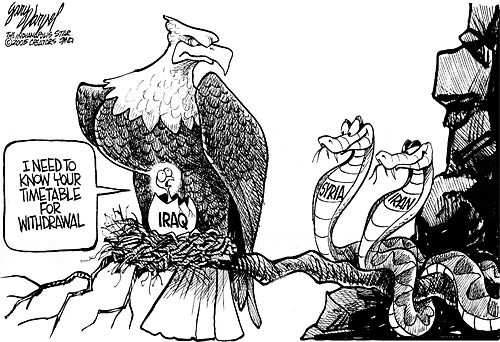
It links to this nifty cartoon in which maleavolent vipers labled Syria and Iran hover, detered by a powerful American eagle, while a little Iraqi baby eagle says, "I need to know your timetable for withdrawl." Indeed anyone in his situation would like to know when it would be that they would be abandon to the vipers.

On the nature of the debate over Iraq and the consequences of an early withdrawal.
Belgian Woman: Suicide Bomber

Another Western seeker has been found on the other side. Muriel Degauque, the so-called "Belgian Kamakazi."

Monday, November 28, 2005

Springfield Mill to Become Home of Nanotechnology Innovation

The 76 year old MFA building will become home to research and development companies, says News-Leader.
The Myth of the Scandinavian Model

In July, I posted about Sweden's shift from Socialism to Liberalism citing the downloadable book, Sweden after the Swedish Model. More recently, the Brussels Journal has compared the Scandinavian economies with others, in particular, Ireland. Charts a-plenty demonstrate the Liberal (liberty seeking) notion that low taxes stimulate growth while high taxes combines with generous welfare benefits result in stagnation and decline. Further, Ireland's tax structure puts relativly more emphasis on taxing consumption, rather than the more usual suspects of labor or capital.
Pentagon Podcasts

The Pentagon is bypassing the MSM with its own internet streaming and podcasting. Streaming can be found at pentagonchannel.feedrom.com and podcasting links are found here.

Sunday, November 27, 2005

Reverse Vietnam

Instapundit has a good post on Iraq and Vietnam. With the situation in Iraq, I have taken a longer and harder look at Vietnam, including reading Jim Dunnigan's Dirty Secrets of the Vietnam War and Max Boot's Savage Wars of Peace. My own thinking is reflected by the Tom Plank e-mail to Reynolds, "I am deeply skeptical of the claim that the military misled the press or the American people about the Vietnam War. [...] I thought the reporting on the war was nevertheless much more negative than what was actually going on."

One of the things that certainly different about Vietnam is that the military learned a lot of hard lessons about how to fight a large scale insurgency. This time around there is more nation-building, no attrition strategy, and no Johnson/Westmoreland happy talk. Apparently there is enough happy talk out there to give Jane Hall the notion that it should all be a ribbon cutting, but anyone who pays any attention at all hears analogy to the long twilight struggle of the Cold War, a long hard slog, and the like.

"The battle in Iraq and the battle in Afghanistan; it will be a slog, a long, hard slog. ...We're finding these terrorists where they are, and we're rooting them out, and we're capturing them, we're killing them. It's difficult work. It won't be over any time soon. And I will close by saying it will be a long hard slog, indeed."
Not as New as Some Think

Newsweek (via MSNBC's web site) thinks pod-casting lectures is new. Putting these things on televison, the campus public broadcasting channel, or the internet is not brand new. Podcasts are just the newest form of an older phenomena.
A Ribbon Cutting?

Today on Fox News Watch, Jane Hall said that coverage of the Iraq War should be negative because the war isn't "a ribbon cutting."

Saturday, November 26, 2005

Insurgency

I don't get the claims that argue that Iraq isn't an insurgency. The Department of Defense (JP 1-02) defines "insurgency" as, "An organized movement aimed at the overthrow of a constituted government through use of subversion and armed conflict."
Good News on the New German Chancellor

Dawn's Early Light reports that in one tour through Europe, Angela Merkel, "has distanced herself from the non-democratic Russians, usurped the stumbling French, and opened the door to the outsider British while affirming America's role in European security."

Tuesday, November 22, 2005

Some Star Wars thoughts

Picked up Ep III and have watched all the extras (and the movie). I really miss the rebellion stuff with Mon Mothma, Bail Organa, and Padme Amadala plotting to stop Palpatine in the Senate. The stuff where the Jedi are doing this, seemingly by themselves, is far less satisfying than it would have been if the plots of this group had been in the film.

1) It makes the tragedy of Anankin's sticking with Palpatine even more painful to realize that Padme was organizing against the Sup-Chan.
2) As it is, the struggle seems to be between Palpatine and the Jedi for control and influence, but with the future rebels, its more like Palpatine against everyone he hasn't tricked and co-opted. The more broad-based and legitimate the resistance to Palpatine, the more Anakin has been seduced (the word Obi-Wan uses several times in Ep IV) rather than acted on legitimate grievances against the ambitious jedi.
3) It sets up another layer of connection and continuity with later films, where we heard about Bail Organa, see a little of Mon Mothma, and know about the rebellion.

My brother has posted on EP III recently. He's concerned about the curious style of acting involved. I make several points on that subject. 1) These people are largely artificial people. Like a lot of politicians, they have a fake front, and that false presence is visible. 2) Lucas doesn't want character to get in the way of his mythology. 3) Lucas' direction is as off-kilter as he is. Interviews with Lucas kind of reveal him to be stilted and wooden. Interviews with directors are often less smooth and silky than those with actors, but Lucas is particularly unnatural. I suspect he just put himself into those roles. 4) Palpatine and Obi-Wan were established characters. That might have created a bit of room for those actors to work. 5) Hayden Christenson is the Anthony Perkins of his generation. 6) Natalie Portman is a good actress, but couldn't get out from under Lucas' direction. Watching the extras, Lucas appears to think you show emotion by turning away from the camera.

This isn't an argument its a list of observations.
Is Wobbliness New?

There is a sentiment out there ( I hear it a lot, most recently in Hugh Hewitt) that at one time Americans understood and supported their wars. I cite the large number of Tories during the Revolution, the consideration of succession in New England during the War of 1812, the serious Copperhead movement in the Civil War, the draft riots during same, the American Anti-Imperialism League, the WWI draft resisance movement, and only then do we get to Vietnam. American wars have been beset from the begining by large segments of people who didn't support the wars of their own generation. WWII is an exception in part because both the left and the liberals accepted the fight against fascism, and the right is generally willing to fight other rightists. And yet even then, we can point to the exceptional delay in getting involved in the war because of isolationism. From 1939 to 1941, Americans did not undertstand war or the neccesity of defense against a hostile ideology. Going Wobbly is as old as the Republic.

Tuesday, November 15, 2005

Wargames use in Analysis

There is a good piece up recently over at Strategy Page on the analytical use of wargames.

"What about the war on terror? From a wargamers perspective, it’s not a difficult conflict to simulate. [...] Same with the war in Iraq, or Afghanistan. Both countries are behaving as they have for centuries. Anyone familiar with the history of these two places, won’t be surprised with what’s going on there now, or how it’s all going to turn out. Forget the media, they haven’t a clue, and don’t need one to stay in business. Remember, wargamers are also historians. They look at things from a historical perspective, and immediately apply an OR approach to any even they are studying."
Tigerhawk updates Den Beste

See the revised and annotated Strategic Overview here.
Podhoretz on the "Bush Lied" meme

John Podhoretz has a discussion of the "Bush Lied" meme in Commentary. It includes quotes from Democrats in 2002 that those same Dems try to dodge today.

Monday, November 14, 2005

Riots in France

Gina Cobb poses some interesting questions that have not been addressed much.
Gateway Pundit has a nice round-up with pics, locations, and a chart or two.

When Katrina hit, the c18-L list was very active with posts on what this reveals about America's dark under-belly. As of the last time I looked (maybe yesterday) there has been no comment on this, and its been going on for a long time.

Tuesday, November 08, 2005

From ancient grudge break to new mutiny, where civil blood makes civil hands unclean.

Such is the nature of revolution, that once begun, it is hard to end; at least for everyone. I have been witness to an office revolution that was originally caused by a spectacularly bad manager. Everyone had great discontents and these were generally known. What was missing was some action to set things over the edge. Of course this could be some 0utrage by the manager, but might also be the act of a praticed revolutionary. In this case, enter the revolutionary. A practiced hand at office politics, this individual had twice before conducted revolutionary actions in the workplace. Once to oust his boss and take her place, once with little effect on behalf of others more agrieved. This effort would be the third such effort. For some time he had been willing to follow the banner of another, but took no action on his own.

Enter another, more radical revolutionary. He proposed a more radical agenda with no widespread support.

Concerned that this more radical revolutionary might take the day, if only because he was the only one acting, our more experienced revolutionary decided to act to produce a more moderate revolution. Skilled with the various arts of politics, the moderate won the action of the whole office, and with some bumps, revolution was achieved. However, the radical got little if any of his agenda. Others advanced their agenda broadly, sometimes too hurridly, but the radical got nothing. So he continued to foment revolution, but as a radical cell disconnected from his peers, and indeed against his peers. Our moderate revolutionary now found himself in the role of a counter-revolutionary, like Washington putting down the Wiskey Rebellion.

Saturday, November 05, 2005

Salafi Jihad

I've found Marc Sageman's Understanding Terror Networks to be very useful. Recently I've been reading Fawaz A. Gerges The Far Enemy. Its a vert good compliment to Sageman, since they cover the same material, but draw on different sources and vary a bit in their emphasis and interpretation. Sagemen asks, who are the terrorists, and after a history of the Salafi Jihad, considers their background, experiences, education, social class, and other factors which dispell myths about who the terrorists are. Gerges explains that among jihadists, the concern with the far enemy is unusual, and tries to explain why Al Qaeda made this move to internationalize jihad. Sageman discusses this, but not with the depth and sophistication of Gerges. Of course Sageman deals with some things better than Gerges as well.

Monday, October 31, 2005

Enough Rosa Parks

I'm not a big fan of Rosa Parks. Everything I have seen points to her as a fellow traveler or perhaps a useful idiot of Communists. I'm not happy with the selection of this one person for sainthood, when there were so many people laboring for civil rights all over the place. I have the same objection to every city having an MLK blvd. Pick a civil rights leader from your home state. You have one, they worked as hard, and some of them too were martyred by klansmen or their allies. Show me a George Washington Carver monument, school, or street in Missouri (he was born near Diamond Grove MO) and I'm much happier. There is a constellation of black civil rights heros, from the gradualist Carver to duBois to the Black Nationaist Garvey, just to pick some more or less contemporary figures. That constellation is much richer in its conflict and contradiction than is any unified view of one figure, something that often just amounts to a hagiography. Especially when someone like Parks is reduced to the dignified seamstress with tired feet, rather than the political activist that she was.

Its complicated in that so many opponants of the civil rights were racists, and were inclined to throw around the communits lable rather freely. However, its worthwhile to note that the racists can be right in calling Communists "Communists" and the Communists can be right calling the racists "racists". An error in one or many areas does not mean they cannot be right about others. The Communists were eager to advance the civil rights cause, but not wholey because they sought equity, but because in part because they wanted to disrupt American society. Its this last part that is a taint. The very nature of a fellow traveler or useful idiot (depending on whether or not you understood the Communist role) is that they advance the cause of the Communists because some other cause you support is also advanced. Learning how to do useful things without Communists was a neccessary and useful development for unions and other Left organizations. The civil rights movement never made that leap, and its more recent history has floundered I think in part because of this inability.
Sam Alito

Bush gave 'em the fight they wanted, he will name Sam Alito to the high court in a few hours, or so it now appears solidly.

Tuesday, October 18, 2005

My brother's current blog page has nothing! Lapse I say, lapse!
"alleged insurging rebel militants of non-specific ideology"

Ah, Mark Steyn. He's not on my extreamly short blogroll for nothing.

Interestingly, he touches on an issue I made a few days ago about the intelligensia and wishful thinking. Steyn writes:
"I underestimated multiculturalism. After 9/11, I assumed the internal
contradictions of the rainbow coalition would be made plain: that a
cult of "tolerance" would in the end founder against a demographic so
cheerfully upfront in their intolerance. Instead, Islamic "militants" have
become the highest repository of multicultural pieties. So you're nice about
gays and Native Americans? Big deal. Anyone can be tolerant of the tolerant,
but tolerance of intolerance gives an even more intense frisson of pleasure
to the multiculti- masochists. And so Islamists who murder non-Muslims in
pursuit of explicitly Islamic goals are airbrushed into vague, generic
"rebel forces." You can't tell the players without a scorecard, and that's
just the way the Western media intend to keep it."

Indeed. Just like the academics, they have a way they want to interpret the world and they won't let the facts get in the way of that. So why is that? In this case, I think Steyn is right to attribute it to multiculturalism. People have trouble moving the particlular (metropolitan) to the general (cosmopoilitan) without becoming hostile to the parochialism of the particular. This is because people have a hard time with "and" and an easy time with "or". They don't like competing goods, and prefer a good/bad binary opposition. So when people move from metropoloitanism to cosmopolititanism, they frequently become hostile to the metropol. As such, by embracing the broader world, they become anti-American. For journalists, who aspire to be people of words and ideas, this means rejecting the American view of things, not so much that they root for the other side (such as some Leftists do - a habit picked up when there was a Soviet system to root for). So they seek neutral words in order not to take sides. Hence the "alleged insurging rebel militants of non-specific ideology."

There are two alternatives. One is the "and" position. All people are good, universalist yeah, and up with people, and America is good, wants these things in its words and deeds. Some people see the Iraq was as Americans against Iraqis, others see the Iraq war as Amerians with Iraqis against tyranny of various forms.

Another alternative is the "truth" position. In this case, you regard both American claims and other claims as just that, claims, and seek out the truth based on the best evidence. Further, you describe things as they are, regardless of who is pleased or displeased. You need a certain amount of sophistry to do this, because you need to hold all the competing ideas in your head as viable claims to be tested. To do this well you need to avoid impeaching the good evidence with the bad. For example, just because it is in figure X's advantage to say Z, doesn't mean Z isn't true. Second, you need to be able to recognize partial truths. Even if you are unwilling to say that Z is true, does X have a point? Is there some truth, a truth that may need nuance, but a truth that can't just be rejected. Too often the press reports government statements as if they were just claims absent any truth, or possessed of some unknowability. Then evidence is assembled to argue for the opposite point, even when that looks like special pleading to the informed.
Lileks on ElBaradei

"Let's look at Mr. ElBaradei's highlight reel: Completely whiffed the Libyan nuke program. Failed to notice that Iran had a secret nuclear program going for a fifth of a century. (You can hardly blame the U.N. types – it was secret, after all. I mean, it's not like you can barge in and say, "What's all this, then?") The IAEA also didn't have a clue about A.Q. Khan, the wannabe Bond villain who ran a nuclear Wal-Mart for rogue states. Mr. ElBaradei would have been better off sending Mr. Magoo to ferret out Mr. Khan's network; at least Mr. Magoo would have tripped over something."
Audible Althouse

These are some interesting podcasts. Clever, idiosyncratic, and worth listening to.

Monday, October 17, 2005

Bennett and the Babies

I came across William Saletan's human nature submission on Bill Bennett's statement about abortion and black babies. I think its clear that Bennett was proposing a straw man in order to knock it down. When you create a straw man, you mean it to get knocked down. He created a case against utilitarian arguments against abortion so obsene no one would be willing to cling to it. That is why he followed up with "ridiculous and morally reprehensible." People who took Bennett's straw man argument seriously are apparently unable to distinguish between the two. John McWhorter's line about this was, "Mr. Bennett, actually, was rejecting a possible defense of his own pro-life position. He was demonstrating thoughtful nuance. I assume that the rest of us, black and white, can too. " Jonah Goldberg offers "The former philosophy professor picked a hypothetical that he thought would make the horror of such utilitarianism obvious to everybody. [...] Bennett's real mistake was in thinking people would be mature enough to get it."
When the Intelligensia Wishes Upon a Star

LGF links to a piece in the Guardian that makes a familiar mistake. The author, a “leading black intellectual and anti-racist campaigner,” engages in some wishful thinking that the terrorists' campaigns are "struggles against poverty, against dictatorships and against foreign occupation." He's hoping for "a profound and desirable shift in the anti-imperialist struggles waged by the Muslim world: away from individual acts of terror, to mass, collective action that finds common cause with the anti-globalisation, anti-imperialist movement beyond it."

I've seen academics make the same mistake, interpreting the war on terror in terms of Marxist theory or some other Leftist template. Rather than interpreting the current events in terms of what I already knew (entirely) I looked at arguments being made by others, and found Marc Sageman and Fawaz Gerges. Their argument follows the ideas of the Salafi jihad through their development, debates within the movement, and getting to the current situation. I did have some applicable knowledge, since the nature of insurgency is something I look at. But what I knew applied mostly to what the coallition should do in responce, rather than being able to answer "why did it happen / who are they."

This failure by many on the Left to recognize the real nature of the Salafi jihad is not only a great analytical mis-step, but it has resulted in a few Lefties, possessed of clearer understanding, breaking with the rest. Christopher Hitchens may only be the more famous example. With this kind of thinking coming from the intelligensia, the whole Left is polluted by an analysis that is so wrong, its worse than useless, its dangerous. And as those like Hitchens and David Horowitz makes clear, this failure to understand means that the causes of the Left are most at risk. This "unholy allaince", as Horowitz puts it, is nothing short of an abdication of what the Left has believed in order to interpret the current situation according to those beliefs. Or to state it plainly, imagining that Islamist terrorism is not part of a fascist (or at least reactionary) attack on modernity, freedom, diversity, self-determination, but rather some kind of fellow traveling "struggle against poverty, against dictatorships and against foreign occupation." To believe that this imperialism of reaction is a Marx-compatable anti-imperialism is to get it exactly backwards. Neither the current pronouncements, the actions, or the history (the Afghani jihad was against Soviet athiesm in a Muslim land) of the Salafi jihad seems to have any influence.

Sunday, October 16, 2005

Deciding Rightly

The NYTimes has a peice on American's lack of science savvy.

"American adults in general do not understand what molecules are (other than that they are really small). Fewer than a third can identify DNA as a key to heredity. Only about 10 percent know what radiation is. One adult American in five thinks the Sun revolves around the Earth, an idea science had abandoned by the 17th century."

Folks on the left point to something like this as evidence that people cannot decide rightly. So many public issues involve science: "If you don't know what a cell is, you can't make sense of stem cell research." Of course many issues are the opposite. Many issues, such as which car you should drive, are such that experts cannot know what is best in your particular situation, and individuals are experts in such matters.

There are two issues here:
people are persuadable
a group full of people with imperfect knowledge can make decisions that are good enough

Because people are persuadable, when an object of knowledge moves from the realm of the well educated person to a political issue, we can explain the issue as evidence for our argument. This happens all the time with specific facts. While I do prefer that people understand the basic workings of physics, chemistry, and biology, but given that it is not so, I am content that people can be informed when an object of knowledge becomes a policy issue.

Second, the essense of democracy is that people can govern themselves, and that the best and brightest (aristocracy) are not required for governance. I am not a Jacksonian, suspiscious of the best and brightest, but am well aware of the dangers of too much confidence in the best and brightest. When you know you're right and the people reject your great ideas you have two choices, stand down and wait for them to embrace your ideas, or force it on them. If you stand down, you are a democrat, yielding to the will of the majority. If you impose, you are aristocratic (at best) and have two choices. When people resist, comprimise or repress. Too often, small minorities convinced of their ideological rightness have been willing to repress the majority to maintain their prefered policies. So, to conclude, I don't suspect the best and brightest, but I do suspect when they think they know better than the people.
American Elites

Instapundit describes it as "an elite problem." Michael Barone writes in USNews about the disconnect between America's elites and its populace. One could tease this even further, and distinguish between the cosmopolitan character of most elites, the concept of the revolutionary vanguard, and their attitude toward the people.

Elites have always been cosmopolitan, will ever be so. The question to ask is whether their cosmopolitanism is in addition to a strong Americanism, or whether its an either/or proposition. Barone's mention of FDR is an example of Americanism plus cosmopolitanism. (I suppose the proper parallel formulation here is metropolitanism and cosmopolitianism. Metropolitan refers to the mother city, and so has a meaning similar to patriotism, which refers to a fatherland.)

Elites often think that their job is to conserve the heritage and greatness of the society in which they are elites, but elites can also be strong advocates of progress. The Enlightenment was an elite effort, and large landowners in England were behind the second agricultural revolution. Above, I used the Lennist phrase, "vanguard of the revolution" and it was done as much to suggest elite change leaders as it was to suggest a leftist reconstruction of society. Part of the elite problem discussed by Barone is the Leftism of many elites. Their vision of America is substantially different from the people's (see next item), but what is pretty clear is that they seek significant change.

Elites can regard themselves as the first servants of a society, restrain themselves with nobless oblige, and have something of a paternalistic concen for the welfare and happiness of the people. The elites we are confronted with today, and which Europe has labored with, regard the people as incapable of deciding rightly and in need of leadership: what Lenin called the dictatorship of the proletariat. A tyranny in the name of the people lead by idealogues in contempt of the people.

We can certainly imagine an elite that is cosmopolitan, advocates progress, and regards the people as the reseviour of wisdom, greatness, and values encouraging change in society. Much of the history of America has seen an elite more or less cosmopolitan which had a deep faith in technology and technological improvement, even accepting unpredicatble social change as a consequence. A feature of the problem Barone identifies is the contempt for the people as ignorant, superstitious, and incapable of right understanding.

In discussions with people on the center left I have seen this notion of the people having been fooled by the Republicans, the need for slicker advertising, redefining the terms of debate, more telegenic candidates, and other issues of style rather that substance. It certainly reasonable for the Democrats to argue that the country is evenly split and that they just need to persuade people of the quality of their ideas, but too many on the left don't give the people the benefit of any belief in their ability to think for themselves.

Thursday, October 13, 2005

Bennett and Credentials

Bill Bennett has been opposing Meirs on the basis of her lack of credentials, record, and intellectual gravity. Supporters have been making Jacksonian arguments that Meirs' character is right, and so she is qualified. Bennett however has been making weak arguments against the Jacksonians. I called the show and said as much, but it was clear by the end of it why. Bennett is himself too much of a Jacksonian to attack the assumptions of that kind of American. It seems obvious in hindsight that Bennett is a believer in character as a qualification for office, but in his opposition to Meirs he has relied on his Jeffersonian side. As such, the Meirs supporters might be described as "character only" and Bennett as "character plus". Contrast this to Dennis Prager's critique of character. Prager makes several attacks on a character only position. He points to the errors of good intentions. He identifies that there are people of good character who hold to bad ideas. For instance, he regards GHWB as being an excellent person and a poor president. Carter might even be a stronger example. For Prager, character is not a reliable guide to public performance. This can also tie into his public-private distinction. I think Prager likes good character, but regards it as much weaker as a qualification for right political action. This is why Prager can bring stronger arguments to bear against the character issue. Jacksonians are suspicious of sophistication, and Bennett is seeking sophistication. But the Jacksonians want character (and regard character as suficient) while Bennett wants character as well. So Bennett, who wants character plus, fails to offer a really good criticism of the character only argument.

Tuesday, October 11, 2005

Flu Pandemic

The CDC has a six phase description of pandemic, from phase 1) the disease exsists, but is not a serious risk, to 6) full blown pandemic. It appears we may be in phase 2

Phase 2: No new influenza virus subtypes have been detected in humans. However, a circulating animal influenza virus subtype poses a substantial risk of human disease.

Pandemic alert period
Phase 3: Human infection(s) with a new subtype, but no human-to-human spread, or at most rare instances of spread to a close contact.

Once we start hearing about human to human spread or mutations of a new subtype in humans, then we're up to stage 3. The Survival Manual suggests preperation well ahead of serious threats. Plan now.

Sunday, October 09, 2005

Slate slips a shade closer to a Blog

There are blog things that can work well for an on-line publication, like Slate. Nearly all of them have embraced links, but Slate has started to put additional links below articles. These link to related articles by the same author, other authors, and other sites that cover the issue. TCS has a bar on the left side with some of the same stuff.
Hugh on Party

I first found Hugh Hewitt because James Lileks described him

Generally, I have been very happy with Hewitt, and through him, have discovered Dennis Prager, whom I also value. I did have a problem with Hewitt's "gang of seven" talk of purge back in may, but its good to see Hugh arguing for victory over ideology (the half a loaf is better than no loaf theory of politics). Stephen Bainbridge is typical of many whom I have seen, in numbers growing since victory in the Iraq War, who wants a full loaf and disparages the half he has won. I think that many such critics, have sound criticisms, in so much as their loaf is not as full as they desire. The problem is, there is no such thing as a full loaf. So the better question is, how much of a loaf is it reasonable to expect given my views and the present political climate. Further, when you find that your desired portion of loaf is too small, rather than attacking the politicians who operate in a given political climate, one instead should advocate for change in the political climate, not the politicians closer to your position and party.

I sympathize with Baimbridge in that without 9-11, I too would be unhappy. But those as conservative as Baimbridge, who attack Bush from the right should also understand that I would be opposing them from the center if they had sway. My priorities in politics start with foreign policy, move to economics, and then to domestic politics. As such, being right on Iraq and taxes, and being wrong on everything else counts for quite a lot for me.

One current critic, at least of the Miers nomination, Bill Bennett has argued that the SCOTUS is a great seminar. Therefore the person nominated must be capable of debate, rich of ideas, and able to advance the causes to which the nominating President's supporters seek such advance. This argument troubles me because the only cause I seek advanced in the court is that the court stops legislating. I want an irrelevant court which merely requires the actual legislature to fix its bad laws. I certainly do not want the court taking on an activism of the right. I want the court to simply ignore bad precident, not over-turn it. Let the court settle into a quietude as soon as possible. The rich debate should not take place in the Court, but first among the people, and second, in the legislature. It is Bennett himself, on TV, radio, print, and web, that advances debate. Let the Justices be mere technitians of the law.

Sunday, October 02, 2005

Fellow Traveling

How does fellow traveling work? Take a look at this Anatomy of a Photograph. As you can see by this example, a fellow traveler is someone who is sympathetic to some part of a radical, generally communist, agenda, and overlooks those parts they might disagree with to advance the other part. Indeed, a fellow traveler often overlooks the disagreable part even to themselves.

Friday, September 30, 2005

McCaffery coming to Springfield

Barry McCaffery is speaking at MSU on Tuesday the 11th of October. The News-Leader includes his attacks on the Administration with a rebuttle from a MSU professor. Several related stories take the same defeatist tone. Here, Here, and Here. The last link, "Poll finds scant support...," seems to reflect the coverage. I wonder of one causes the other. If they both cause the other, we have a feed-back loop.

Wednesday, September 28, 2005

Trouble for Transformation

Defence Tech has a piece on problems implimenting transformation. It certainly appears that the solution is fewer armored vehicles and more personal armor. Of course some changes, shifting from divisions to brigades as core units, smarter weapons, better communications are already under way. Making units lighter is the area where troubles remain. Rapid deployment is the benefit, but the ability to stand up in a fight is threatened. I suspect that combat endurance will be achived by abandoning heavy technologies (armor and vehicles) and protecting troops with the lighter technologies, smart weapons, communications, tactics, and training.

Tuesday, September 27, 2005

More Renaissance Conference: reviews

Here is the schedule

Attended "The Shakespearean Stage" though I was tempted to attend "Art History, North and South" but ended up in Shakespear and stayed put. The most interesting paper was "Antitheatrical Tracts" because these issues, and as it turns out, these arguments are still with us today.

Attended "Classical and Humanist Influences in the Late Renaissance." Interesting, but all three papers were heavy on text analysis, such as comparisons of versions of Daphnis and Chloe, assumed qualities (in Bembo and followers) of particular word choices and patters, and so on.

The Museum Demonstration was nice. I've been there many times before, but the presentation was pleasing and informative. Its always interesting to have art de-coded.

Dinner was excellent.

The Plenary talk, "The Facetious Renaissance" was on humor, and focused mostly on how humor operated in the Renaissance with specific attention to how some things they found funny are not commonly funny now, and the reverse. The speaker's personality was strong in the choices made, but given the subject, that's inevitable.

I would have attended "Belief and Ethics in English Thought" but I visited friends the night before, and slept in.

I started Saturday off with "Art History, Images and Patrons." As a graduate student, I had given a gallery talk on the patronage of Marie de Medici of Reubens, and as far as art history goes, patronage and thertefore the political content of art, is the only place I am strong. The Sistine paper reader wasn't there, so we heard about sculpture pieces of St George and John the Baptist above doors, and related objects in Genoa. The speaker, Madeline Rislow of KU argued that Genoa's artistic heritage is undervalued, indeed almost dimissed, but this has more to do with the kinds of art created than the quality of Genoese art production. The second speaker gave a longish (45-50 min) illustrated biography of Alphonso V, Isabella and Ferdinand. It should have found a focus and stuck with that, but it was otherwise interesting. I am reasonably well versed in these figures and had some differences with the speaker, but otherwise enjoyed the paper.

"Faith and Last Things" was the end of the day, and was a very interesting session. The first paper was on a minor author's apocalyptic writings. The second was on the Roman Inquisition, in which the speaker, Jane Wickersham, argued that the Inquisition intended both the recovery of souls and the supervision of the wayward. The last paper was on Mary Magdalene and her use by early modern Protestants (mostly English) as a redeemded sinner. An interesting observation was that where Catholic works theology saw the Virgin Mary as the ideal model, Protestant grace theology saw Mary Magdalene as the ideal model.
More on Intel

Strategy Page has more on some of the same kind of thing I wrote about in the previous post, with specific interest in OPSEC (Operational Security).
Problems at the Pentagon

Andrew C. McCarthy has a good peice on some things wrong over at Defense. Its unfortunate that institutions operate this way, but as James Q Wilson and others have shown in their studies of bureaucracy, this kind of turf activity is as natural as breathing. I am not as familiar with the business literature, but I have seen the same kind of thing there too. Reasons can include glory seeking, empire building, worry that someone else will screw things up, or just being so accustomed to keeping secret information secret that telling someone, even another intelligence agency seems like the wrong thing to do. In business, refoming the old tired ways is so common that Dilbert makes sport of ridiculing the attempts to improve operations. Indeed the reforms are not a panacea, and often are as bad as the problem they are meant to solve. What one must keep in mind is that these shifts are not a question of better or worse, they are a question of shifting the costs around. Peter paying Paul. In its most general sense, one can choose to err on the side of keeping secrets, knowing that some analysis might fail because secrets were too secret; or one can choose to err on the side of analysis, knowing that some secrets might get out. Enter a new problem. When analysis fails, its normally never known to anyone. Does the CIA know where Vladimr Putin is right now? If they don't, the consequences are probabaly very small. Occassionally failures of this kind result in a Pearl Harbor or a 9-11. On the other end of the table is loose lips sinking ships. When secrets get out, its more likely to get noticed, and that means trouble for whoever should have been keeping that secret. So, under normal circumstances, there is a tendency to favor keeping secrets, because it avoids more routine and regular loss of secret information, even though it means occassional lapses in analysis that result in Pearl Harbors and 9-11's.

The US intelligence community used to have to operate with a very aggressive KGB attempting to winckle secrets out of it. The result was a tremendous emphasis on secrecy. Keep in mind all of this follows some spectacular examples of Soviet spies being discovered in American government. Al Qaeda doesn't have spies in the FBI or the CIA, but careless handling of information can still result in operational details or the names of moles (and one hopes we are developing them) getting into terrorists' hands. One example we may all remember is Geraldo Rivera drawing operational maps in the Iraqi sand. Ooops.

Nevertheless, it still appears that US intelligence is still too concerned with secrets at the expence of analysis, which means sharing intelligence with anyone who can help interpret it. This a cultural issue, because lessons have been learned in the intelligence community that go way back to before any of its current members were doing this kind of work. The CIA is over fifty years old, the FBI a few decades older, and Army intelligence, older still. Institutional memory makes an organization risk averse. Since there is more routine risk in sharing secrets than there is in keeping them, that's what intelligence organizations will default to, without strong leadership to do otherwise.
Analysis of British in Iraq

There is an interesting piece up at Belmont Club (new addy, blog got too big to publish) about British operations in Iraq.
How Evan Blew It

Evan Thomas has moved from being reputable to being disreputable because of his Katrina coverage. The fallacies involved in Thomas' coverage have become too burdonsome to excuse henceforth. The fundamental flaw in his coverage is of this kind: The President has characteristics x, y, and z; I am unsatisfied with the Federal responce to Katrina; therefore not only is the President responsible, but his characteristics x, y, and z are the cause of his poor performance. Thomas is now in the Paul Krugman catagory of partisan hacks, as far as I am concerned.

Monday, September 26, 2005

More Renaissance Conference

One of things that puts a little difference between me and the rest of those attending CRC this past weekend is our notions of what the Renaissance actually is. There were art historians, who have a very clear and quite useful sense in terms of art. For example, attention to details like fingers, attempting to portray a figure realistically rather than stylistically, interest in landscapes, and a preference for natual colors rather than expensive materials. The shift from International Gothic to Early Renaissance is clear and makes sense. Something new is at work. The same is true for literature. I am not in a position to describe what is different, but I have enough of a sense of then difference to accept that something new is going on. But for me, the new thing occuring, the thing that needs a name to distinguish it from that which happened before, concerns the nature of the state. For me, the Renaissance is a new era for the state which involves a new emphasis on Roman Law, Roman concepts of soveriegnty invested in a monarch, professional bureaucracies, and a seperation between the person of the monarch and the office of the monarchy. I also look to the new permanent diplomacy, the new structure of international relations, and the military revolution. For me, these are the markers of the Renaissance, not new arts and letters. Certainly I am aware of what the new arts and letters mean for the new thinking, and they are important, but aside from issues of patronage and the political uses of art, the items I have mentioned prove to be much better markers for the Renaissance in the areas in which I work. I probabaly ought to write a paper on this subject for the next time I go to this thing.
Price Gouging

The Missouri Attorney General, Jay Nixon, is on a bender against price gouging. Apparently, the Democrat belives he knows better than the market what the best price of gas is. He also proudly claims Nixon v Shrink, a case heralded on his website as reinstating "Missouri’s campaign contribution limits and cleared the way nationally for campaign finance reform. " This kind of paternalism, including censorship and price controls, is the kind of illiberal regulation of an otherwise free society that makes government the problem.
No Pork

One of Missouri's Senator's, Kit Bond, is good at bringing home the pork. His website frequently advertises what Federal dollars and programs he has brought home. There are various ways to position yourself as a representative of the people. One could advertise your spots on committees or chairmanships of same regarded as important to constituents. One could champion a few issues near and dear to the voters. Or, one can bring home the bacon. Kit Bond is invincible in Missouri, because he can win in Kansas City as well as Republican areas of the state. Looking at his press releases today, its the same as it ever was.
Bond honors hurricane heroes
$23 million for agriculture
Funds for Danforth Plant Science Center
$2.3 million for transportation in Columbia
Bond honored for supporting spending money for HIV/AIDS
Bond speaks to conference, advocates spending money on waterways and infrastructure
Bond keynotes at the opening of a bridge

Kit Bond's theory of government is to spend money to make the people happy. Because he's a Republican, he seems to view infrastructure projects as better than welfare, but he's a big government guy all the same. Tax and spend. He's a reliable Republican vote, but all of his own initiatives involve spending Federal dollars in Missouri. How much more valuable it would be if we had a Senator who championed things that would improve the lives of Missourians and other Americans without spending nearly so much money, such as the Fair Tax, Social Security Privatization, Military Transformation, repealing Campaign Finance censorship, supporting free trade, and otherwise advocating limited government in ways that show up in the press releases.
Conference

I returned yesterday evening from the Central Renaissance Conference in Columbia Missouri. It was very interesting, although since the period was a bit early for me and a lot of the presentations were literary, I was aware of being in a little over my head. There were four papers on Titus Andronicus, for instance. I saw a few people I knew- always a pleasure to renew contacts. I'll review the papers in a subsequent post, all were impressive, some were also interesting.

Since I'm not supported by any institution, I get no travel support and have to take off work to go to these, so I only attend the ones reasonably close to home. This means that I'll go to stuff that isn't in the heart of my academic area or period. I don't go very often, either, but it does a good job of re-connecting me to the values and culture of the acadamy. Being away, either in education or some other employment, carries a different culture and values. Its a sad statement that the culture and values of education and higher ed are so different and so often incompatable, but they are.

Since I participate on several academic mailing lists and do a lot of academic reading, its not so much the ideas of the academy I get back in contact with. Like the latter, I overheard one sustained anti-Bush rant by three literary types which wandered way off the path of sense and reason. I heard one of the participants give a paper, and it was well reasoned and contained solid evidence. Why its possible to abandon these standards in contemporary politics strikes me as very odd.

Tuesday, September 20, 2005

The Nature of Love

MSN Lifestyle has a piece on the two kinds of husbands. To my eighteenth century eyes, this looks like the distinction between Enlightened love and Romantic love. Using the MSN terms, it would seem that a marriage to Husband was the ideal in the early eighteenth cenury, and by the very end of the century and into the nineteenth, Boyfriend was the ideal partner. There is a missing stage, between Englightenment and Romanticism, was the Age of Sensibility, and love in this period is love of the soul mate, the abandoning of the rest of the world for a immursion in the couple. Its the most domestic love. It lacks some of the passion and fire of Romantic love, but none of the depth.

Monday, September 19, 2005

Clinton on This Week

Powerline has a dead on decription of Clinton's truth-challenged performance. John Hinderaker writes:

"Again and again, President Bush has tried to work with the Democrats as if they were loyal Americans first, and partisans second. He has treated Bill Clinton with a friendship and respect that, candidly, is disproportionate to Clinton's meager accomplishments. Again and again, the Democrats have rebuffed Bush's overtures and taken advantage of his patriotism and good faith. Clinton's politically-motivated tissue of lies and distortions is just the latest example out of many. But it is unprecedented, coming from a former President. That is a sad thing: the latest wound inflicted on the body politic by the Democratic Party."
German Elections

Its still being described as a tie, in so much as we don't know who will be Chancellor. Checking out the history of elections in Germany (here) you can see how things have changed in the past decade or so. From market liberalism to socialism. Go Free Democrats!
Home Made Software Upgrades

Those who take a regular look at Jeff Jarvis' site have no doubt noticed the discussions of how products that are out there are now being improved by consumers and the ideas and techniques disseminated by internet. I've been over at the boards for Imperial Glory (see previous post) and players are updating and improving the look for their favorite countries as well as improving things like the way smoke works. Value added indeed.
My "main" computer has been in the shop all week. My CD drive died, and I elected to upgrade to a DVD drive. I also added 80 gig of HD goodness. My other compluter is dedicated to video and doesn't allow me much time to use it for amusements. I tried to install my new Napoleonic war game (Imperial Glory) but it won't work with Intel video chipsets. I tried the fix on their tech site, but it didn't work. So far its still installed on my video machine, but that means I have yet played the game only once. Well, I once again have a computer I can actually use, rather than just having one that renders video all day long.

Tuesday, September 13, 2005

Too Naive?

The neo-neocon posts on the motives of the soft-left and center-left, and then concludes by wonder if she is too naive or giving too much benefit of the doubt. I say that she is not. The left regards the right as bad people because they don't try and get to know people on the right, or Republicans. If they did, they would continue to disagree with them, but they couldn't regard them as bad people. It is by knowing people on both sides that makes it easy to disagree in a honorable way that assumes that the other side has different ideas, but are essentally good people with different values, and hence advocate different policies. The other side can be way off on a few things, but mostly they are just applying a different set of first principles. On both the far right and the far left are those who can't do this and end up regarding even people on their own side as comprimised and unworthy, let alone people on the other side. Such extremists are almost always nuts.

Keeping in touch with people who know the other side, either because of personal experience, or because they sit on the other side, is valuable. Hating people who are bad is neccesary, hating good people because you mistakenly think they are bad is itself bad.

Sunday, September 11, 2005

More on Pacification

Last week I made mention of Robert Kaplan's artical, Imperial Grunts. A few days ago, the LA Times ran a story on the improvements in Sadr City that makes some of the same points.

Saturday, September 10, 2005

The Classical Academy

Number 2 Pencil links to The Classical Academy in Colorado Spring as a reference on the value of memorization of foundational information. I have at various times looked forward to school choice as a source of just such a school with a classically inspired curriculum. The website is impressive and its sources and inspirations are classically grounded. I wonder how much of a classical curriculum it has. I see two years of world literature, in addition to 9th grade English and one year of American. I hope that this is a Great Books approach based heavily on the work of classical and classically influenced works, light on modernism, romanticism, and other 19th and 20th century works, except where merit is overwhelming and to juxtapose how such works are not classical. I would rather students read one too many plays of Sophocles than one too many modern novels. There are three required semesters of world history and geography, followed by a year of American history and a year of Civics. This would appear to support my social studies curriculum with a semester of the Greeks, a semester of the Romans, a semester of English history all building to a knowledge of the Founding and the ideas which are essential to a knowledge of the American experiment. I would cover the rest of world history in an 8th semester.

Regarding character education, my own preference would be for an Aristotelian approach. I see that they integrate character education rather than making it a seperate study. This is the correct approach. Their basic statement in this area is: “We will demonstrate the virtues of integrity, honesty, respect and responsibility, upholding others to that standard.” I was at first given pause when I read the following, "A classroom dialogue which resembles situational ethics is also discouraged. Therefore teachers are encouraged to resist the temptation to create artificial moral dilemmas for students which pit character traits against each other (e. g. family loyalty vs. honesty). " Immediatly the importance of competing values got my back up. Aristotle's middle path is only complete by understanding that an excess of loyalty can lead to the kind of blindness that was characteristic of the US Grant administration. Then I continued to read, "However, issues in history can provide an appropriate place for students to explore the meaning of responsible judgment and action, and to study events that involved complex ethical issues. " Yes! It is indeed better to confine conflicting values to historical examination rather than conjectural situations because in historical examples, the consequences are natural, and not supposed by the author of the dilemma. As in my example of Grant, the specific problems of Grant's loyalty and his assumption of the honesty of his officials are factual. In a hypothetical, the right balance can be struck according to the aesthetics of the author, but in a historical situation, it is the nature of things that governs what is and what is not. This preference for the empirical over the rational pleases your humble author.

They have a nice page of recomended books. I clicked and picked up three of them.

Tuesday, September 06, 2005

Learning Curve

A very good post at EagleSpeak on learning from Katrina.

Monday, September 05, 2005

Why do academics lack the ability to apply their academic methods to news items?

As I follow the responce of Katrina on academic lists, I am shocked by the fact that so called scholars fail to employ elemental methods, such as source criticism, let alone a general thoughtfulness. As I learned various methods of seperating reliable from unreliable information, the historical method, the scientific method, the quantitative method, and so on, I regarded these as useful for distinguishing between reliable and unreliable information. Apparently, this is not typical. It seems that not only do many academics only apply their method to their narrow field, and use wishful thinking for everything else, but most other academics don't seem bothered enough to call them on it.

Sunday, September 04, 2005

Divisions between Liberals and Conservatives

A good piece on the divsisions in the Republican Party between its liberal and conservative wings.
A Strategy for the War on Terror

My own view, based on my study of history from Suchet to Vietnam is that the proper style of war for the War on Terror is counter-insurgency. As such, I am troubled by Bill Bennet's, Bill Kristol's, and others' call for a more aggressive posture in the war on terror. These statements strike me as too much Westmoreland. General William Westmoreland once replied in a press conference that his strategy for counter-insurgency was firepower. His attrition strategy is largely responsible for making the Vietnam war a costly and unpopular war. Aggressive search and destroy missions ripped up the North Vietnamese and their Viet Cong allies, but at too great a cost in American lives. The rival strategies advocated by Lewis Walt, Sir Robert Thompson, Victor Krulak, William Colby and John Paul Vann strike me a much closer to the right approach. You can read about the basics of this approach as advocated by the Marines here and here.

In this month's Atlantic, Robert Kaplan has a great article called Imperial Grunts. Kaplan is right on and puts his analysis right up front in the very first sentences. He draws the right lessons from our various small wars, notes the Small Wars Manual, and demonstrates the success of unconventional warfare approach of the Special Forces.

Bennett has an axiom which states that you are either on offence or defense. And its clear that one does not win on the defensive. If, according to the principles of conventional war, the object is to defeat the enemy in battle and break his will to fight, being on the offensive is pretty strait forward. However, in guerilla and other unconventional wars, offensive actions can be counter productive and the benefits of offensive and defensive can appear to be reversed. To make sense of this we need to understand the principle of strategic offensive and tactical defensive. This phrase has been applied to the campaigns of then Duke of Wellington. Wellington would advance into Jospeh Bonaparte's Spain threatening ket targets, such as Madrid (strategic offensive) but when the French began to prepare to face him, Wellington would adopt a tactical defensive. When Wellington was on the strategic defensive in Lisbon, the French could just go about the business pacifying Spain, but when Wellington advanced into the heart of Spain and then adopted a tactically defensive position, the French had to push him out. Yet, because of his defensive posture, Wellington chose the battlefield and was able to eliminate many of the advanatges of the French artillery and column formations. In Afghanistan and Iraq, the Coallition is on the strategic offensive. We have advanced into the world of the Islamic jihad and the terrorists must drive us out lest we convert these places into modern, liberal states. In Zarqawi's message last year, he expressed concern that as the Iraqi government endures it gains legitimacy and the police and security forces will look like the people and be of the people, making it harder to portray the terrorist campaign there as anything but attacks by Al Qaeda on the people of Iraq. Recall that in Vietnam, the North played the nationalist card, because the Americans did a lot of the fighting directly. If the Americans train, assist, and support local forces instead, nationalist claims wither. Likewise Islam vs the Infidel.

When you look at the Marine strategy of the Small War, you find that its about providing security to the locals, not attacking the enemy. Its about building schools, roads, hospitals, and water treatment. Its about hearts and minds, not about body count. Its not about adopting a more aggressive posture. When I hear that we should get more aggressive, I think I am hearing from someone of the Westmoreland school. This is spot on for conventional war. But off the mark for unconventional warfare.

Saturday, August 27, 2005

Egyptian Democracy

Noman Gomaa, leader of Egypt's oldest and largest opposition party 'Wafd' criticized Mubarak and his Finance Minister on state television. An unprecidented step in freedom in politics there. Democratization appears to be progressing, but Mubarak is missing a chance to be a historic figure in Egypt. Mubarak is 77 years old. He should cloak himself in the mantle of Washington and Gorbachov and be the kind of guy who steps down in the interests of democracy. Keen observers would find him wanting in such a role, given his record, but in Egypt such a step would seccure Mubarak's place as the man who made the transition to democracy peaceful by stepping down. History (Egyptian history at least) would cover him with a glow of the great men. Instead, Mubarak risks his legacy as being nothing more than more autocracy, sham electoralism, or a humiliating loss. Certainly at 77 he can retire.
Pop-Up Irony

What is it about pop-up ads selling pop-up blocking software? Sure they demonstrate the need for the product, but in the way that keying your car demonstrates the need for a paint job. OK, not quite. But certainly they do sacrifice some good will by the tactic. The combination of Microsoft Anti-Spyware and the Google toolbar have kept me pretty clean, but when I'm out and about, I am distressed by the way the machines I see are all eaten up by spyware and adware.
Attempting to Raise the Dead?

There is a new blog devoted to waking the NEA. Every David needs to select some polished stones to take down the Goliath.

Ecraser l'infame

Tuesday, August 23, 2005

Goldmine

Use this Educational Jargon Generator to leverage technology-enhanced interfaces in your work. So armed you can visualize compelling articulation and cultivate "meaning-centered" schemas.
Hitchens on Sheehan

Check out the recent post, and the earlier one. There is also a related piece on what the Left wants.